

Acrylic No Line vs Laminate — the material of the decade?
When choosing cabinet-door materials for a modern interior project, the two names that come up most often are Acrylic No Line and Laminate. This article gives a comprehensive comparison — from durability and aesthetics to lifecycle cost — to help architects, contractors and investors make the right decision.
1. Overview of Acrylic No Line
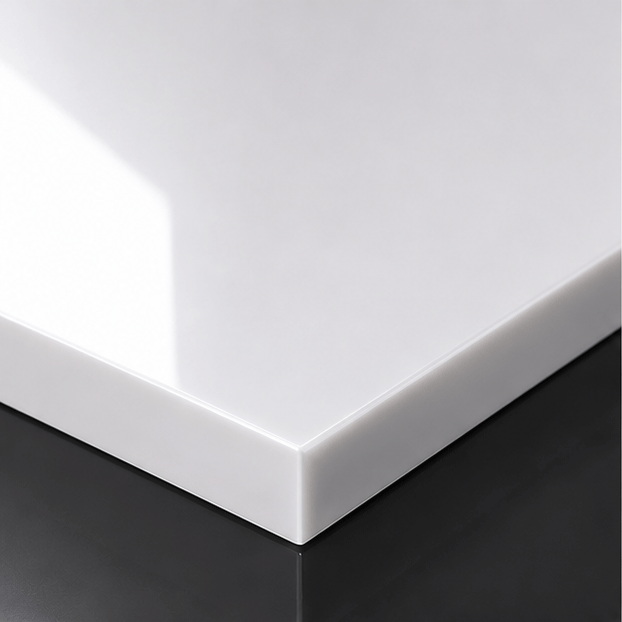
Acrylic No Line is a cabinet door edge-bonded with a special technology that creates a completely seamless surface, with no visible line between the face and the edge. It is a pioneering technology in Vietnam, mastered by LIVAS since 2015.
Key features:
- Bright mirror surface with high reflectivity
- No line on all four edges, for a premium look
- Machining tolerance under 0.1 mm
- Production lines imported from Germany & Italy
2. Overview of Laminate
Laminate is a traditional cabinet-door material — a printed décor-paper layer hot-pressed onto an MDF/HDF core. Popular in Vietnam since the 1990s, Laminate offers advantages in price and pattern variety.
However, Laminate has some limitations:
- A visible line on all four edges, requiring edge banding
- A matte surface with no mirror effect
- Edges prone to peeling after 5–7 years of use
3. Durability comparison
In terms of mechanical strength, both materials perform well. However, for surface durability, Acrylic No Line is superior thanks to:
- A UV ceramic scratch-resistant coating (Premium line)
- No edge peeling, since there is no line
- Better moisture and termite resistance with a moisture-resistant MDF core
“Across the 100 projects LIVAS has delivered, the warranty rate for Acrylic No Line doors is under 0.5% after 5 years of use — far lower than ordinary Laminate (3–5%).”
4. Aesthetics comparison
Acrylic No Line delivers a modern, luxurious look with its bright mirror surface. It is especially suited to Scandinavian, Minimalist and Modern Luxury styles.
Laminate is a better fit for Industrial and Rustic styles thanks to its varied wood grains and matte texture. However, the edge line can be an aesthetic drawback in high-end spaces.
5. Lifecycle cost
Although the initial price of Acrylic No Line is about 30–40% higher than Laminate, in terms of Life Cycle Cost (LCC) Acrylic No Line is more economical:
- Average lifespan of 15+ years (vs 7–10 years for Laminate)
- Maintenance and repair costs 60% lower
- Asset value holds more stable over time
6. Expert advice
For high-end projects (penthouses, villas), Acrylic No Line is the obvious choice. For mid-range apartments, combining Acrylic No Line in highly visible areas (kitchen, living room) with Laminate in hidden areas (storage, bathroom) is the optimal approach.
7. Conclusion
Acrylic No Line represents the cabinet-door material of this decade — superior in durability, aesthetics and long-term cost savings. Laminate still has its place in the budget segment and rustic styles, but is gradually being replaced by higher-end materials.
LIVAS VINA offers a full range of four premium product lines: High Gloss Acrylic No Line, Premium Scratch-resistant Acrylic, Same-colour PET-G and Slat wall panels.