

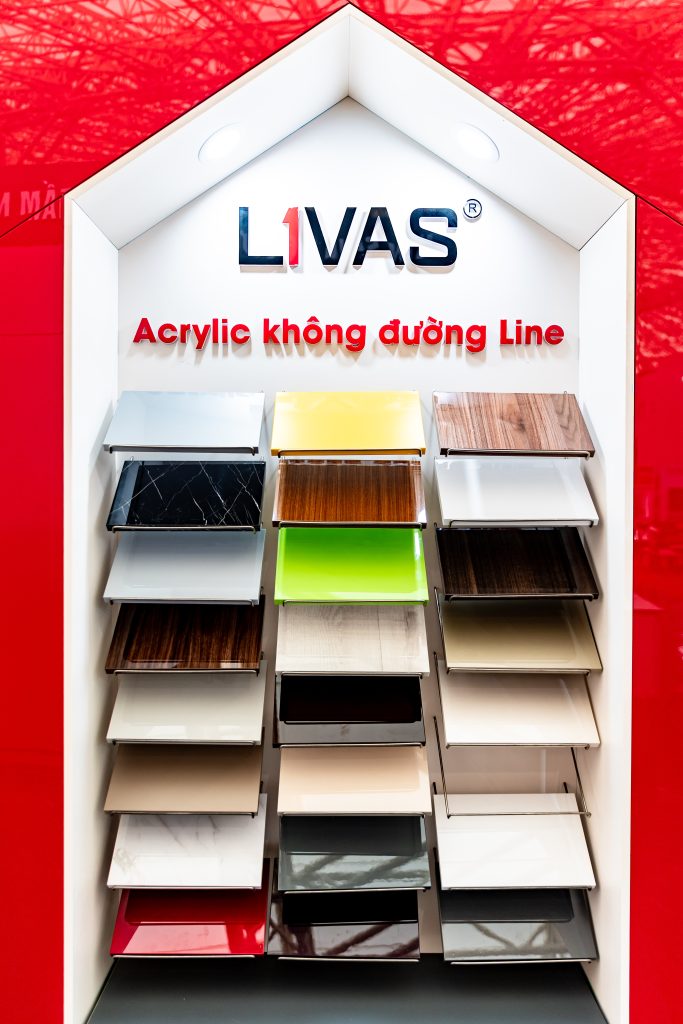
Manufacturing Process of Acrylic Industrial Wood Panels
Nowadays, alongside the advancements in science and technology, many new industrial materials have been created to replace gradually depleting natural materials, and Acrylic industrial wood panels are one of them. Acrylic not only offers high durability but also creates products with aesthetic value, elegance, and a modern feel.
We may have seen or used products made from Acrylic, but many people still do not know what Acrylic is or what outstanding features make it so popular. Let’s explore this article with Livas to better understand Acrylic material and gain a clearer perspective on it.
Structure of Acrylic Material
The structure of an Acrylic sheet is very special, ensuring quality, durability, and flexibility. An Acrylic sheet usually consists of at least 3 layers: a clear plastic layer, an ABS layer, and an outermost scratch-resistant coating.
The inner core of the Acrylic sheet can be green-core moisture-resistant MDF, MFC, HFC, or Picomat plastic wood. The most commonly used core is green-core moisture-resistant MDF imported from Malaysia.
Acrylic is flexible, highly heat-resistant, translucent, and enhances the glossiness of the wood layer, making it widely applicable.
Characteristics of Acrylic Material
-
High Gloss: Acrylic sheets create a striking, youthful, and modern look for your interior space due to their extremely high mirror-like gloss. Additionally, the material is environmentally friendly and safe for consumers.
-
Flexibility: Acrylic is pliable, allowing it to be molded into various products.
-
Easy to Clean: Smooth surface that resists dust, making it easy to wipe down and saving time during cleaning.
-
Restorable: Light scratches on the surface can be polished back to a like-new condition.
-
Color Variety: Superior glossiness with a wide variety of choices, featuring over 50 different colors.
Manufacturing Process of Acrylic Industrial Wood Panels
The production process of Acrylic industrial wood goes through the following steps:
-
Step 1: Selecting the Wood Core
-
The core directly affects the quality of the final Acrylic panel.
-
It must meet requirements for a flat, smooth surface, a thickness of at least 3mm, and no deformation.
-
Commonly used cores include MDF, HDF, MFC, and plastic wood.
-
-
Step 2: Cleaning the Acrylic Sheet and Core Surface
-
Specialized chemicals are used to clean the wood core and the Acrylic substrate. Even a tiny dust particle can cause significant flaws after pressing.
-
Surface cleaning is strictly prioritized to ensure aesthetics and prevent defects.
-
-
Step 3: Applying Adhesive
-
This is a crucial step. To ensure the adhesive is spread evenly across the surface, the process is fully automated by machines.
-
Adhesives with poor bonding strength for Acrylic, such as contact cement (keo dog) or spray adhesives, should be avoided.
-
-
Step 4: Pressing the Acrylic Sheet
-
This step is also automated in the order: adhesive application – heating – pressing the Acrylic sheet.
-
The pressing force is critical: it must be strong enough to squeeze out all trapped air, but not too strong to deform or crack the Acrylic sheet.
-
Applications of Acrylic Material
-
Promotional & Gift Items: Widely used for manufacturing publications, souvenirs, and gifts.
-
Interior Design: Used for partitions, storage boxes, wardrobes, and kitchen cabinets.
-
Signage: Used for company signs and advertising boards.