

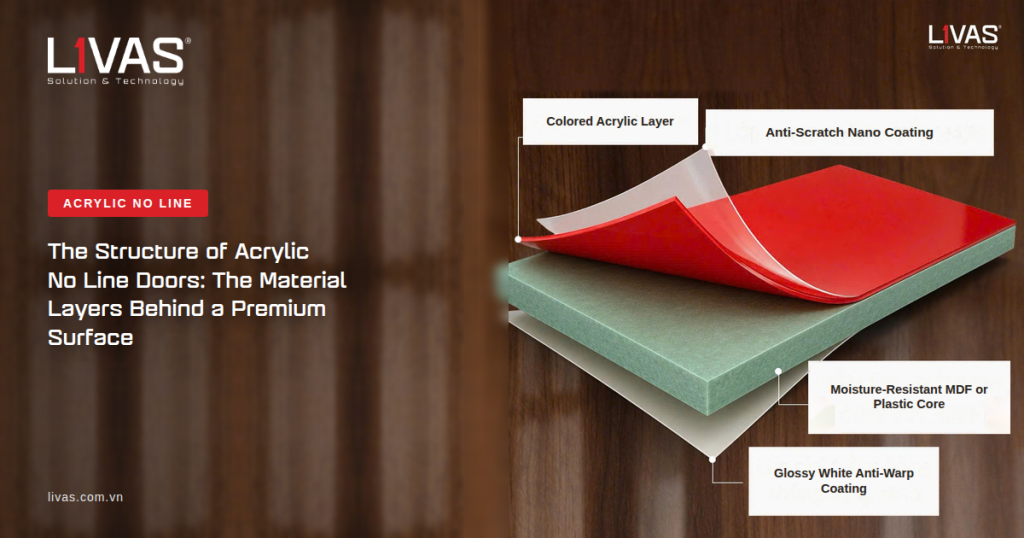
The Structure of Acrylic No Line Doors: The Material Layers Behind a Premium Surface
To understand why Acrylic No Line doors deliver such outstanding durability and aesthetics, it helps to understand the material layers that make them up. Each layer in an Acrylic door plays its own role, from providing rigidity and moisture resistance to creating the surface color and shine. LIVAS currently offers Acrylic No Line in two lines to suit different needs: the standard line (color code LV) and the scratch-resistant line (color code LVH).
Basic Structure of an Acrylic No Line Door
A standard Acrylic No Line panel typically has three main layers. The inner core is usually an engineered wood board such as MDF or MFC, providing the door’s rigidity and shape. The outer Acrylic (PMMA) coating is heat-pressed directly onto the wood core’s surface, creating the signature shine, color, and premium feel. The edge is finished using No Line technology, which fully covers the door’s edge without leaving the visible seam line found on traditional edge-banding methods.

The Role of Each Material Layer
The engineered wood core is the door’s main load-bearing frame, determining its rigidity and resistance to warping. In premium lines, the MDF core is typically moisture-treated to boost durability in high-humidity environments like a kitchen. The outer Acrylic coating isn’t just for looks — it also helps protect the core underneath from direct contact with water, grease, and minor everyday bumps.

The back of the door is usually coated with a layer of ABS plastic or a similar material to balance moisture between both sides, limiting warping over time — a technical detail that’s important but often overlooked by buyers when choosing a product.
No Line Edge-Banding Technology in the Structure of Acrylic Doors
The biggest difference between Acrylic No Line and standard Acrylic doors lies in how the edges are processed. Instead of gluing on a separate edge strip the traditional way (which tends to reveal a seam line over time), No Line technology finishes the edge seamlessly with the main surface, making the door look as if it were shaped from a single solid block — upscale in appearance and with minimal risk of edge peeling.

Why Does Structure Affect Product Quality?
The quality of an Acrylic No Line door depends heavily on the quality of each layer as well as the manufacturer’s heat-pressing and edge-banding process. Lower-quality products often use a non-moisture-resistant wood core, a thin Acrylic coating, or a substandard edge-banding process, leading to peeling and yellowing after only a short time in use. That’s why, when choosing an Acrylic door, buyers should look closely into the construction and manufacturing process of their supplier.

Whether you’re a homeowner looking for finishing materials for your kitchen or wardrobe, or an architect, contractor, or workshop owner who needs a steady supply of Acrylic No Line doors for multiple projects at once, LIVAS can meet your needs. With production facilities across multiple regions, LIVAS supports fast delivery and provides material samples (Swatch Box) so you can check color and quality in person before deciding, and is currently partnering with thousands of workshops and contractors nationwide.
FAQ — Frequently Asked Questions About the Structure of Acrylic Doors
What’s the difference between an MDF core and a plastic core in an Acrylic door?
An MDF core is engineered wood, with good rigidity and load-bearing strength but requiring moisture treatment; a plastic (solid resin) core offers absolute moisture resistance but typically differs in price and weight compared with a wood core.
How thick should the Acrylic coating be to meet a good standard?
Acrylic coating thickness varies by manufacturer and product line; it’s worth asking your supplier for this specification directly to compare quality across options.
Why doesn’t Acrylic No Line peel at the edges like regular edge-banded doors?
Thanks to seamless edge-banding technology, the door edge has no separate seam that’s prone to peeling the way traditional edge strips are, which significantly boosts the door’s durability.